November 25, 2026
CPCSC implementation guide: what a small defence supplier can handle internally
By @cyberreadinessjournal
Understanding the scope of internal work
For a small defence supplier, the prospect of achieving CPCSC certification can feel like a mountain of unfamiliar requirements. The first question most owners ask is: how much of this can we do ourselves, and where do we need outside help? The answer depends on the size of your team, the complexity of your existing security posture, and the budget you can allocate. But in general, a well-organized small business can handle a surprising amount of the implementation internally, especially if it adopts a systematic approach from the start.
The key is to break the work into manageable chunks. CPCSC implementation is not a single task but a series of interconnected activities: understanding the standard, assessing your current state, documenting policies, training staff, and planning remediation. Each of these can be tackled with internal resources, provided you have someone who can own the project and a few hours each week to dedicate to it.
What the standard asks for
The Canadian Program for Cyber Security Certification (CPCSC) sets out security controls that a supplier must demonstrate. For a small business, the relevant controls often cover areas like access control, incident response, security awareness, and supply chain risk management. The standard does not prescribe a specific technology or tool; it asks for evidence that you have thought about risks and put reasonable measures in place. This evidence can take the form of written policies, logs, configuration records, and training records.
A small supplier can internally develop many of these artifacts. For instance, writing a security policy that describes who can access what data and how accounts are managed is something a business owner or a senior manager can draft. It does not require a dedicated security team. What matters is that the policy reflects your actual operations and that you can show it is followed.
Building a responsibility matrix
One of the most useful internal exercises is creating a responsibility matrix. This is a simple table that maps each security control to the person or role in your company who is accountable for it. For example, the person who manages the network might be responsible for firewall configuration, while the office manager might be responsible for visitor access procedures. By clarifying who does what, you avoid gaps and duplication. A responsibility matrix also makes it easier to track progress during the implementation.
You can build this matrix in a spreadsheet or a shared document. The act of filling it out forces you to think about your current division of labor and whether any critical control has no owner. If you find a control that no one currently covers, that is a gap you can address internally by assigning it to someone or by training a staff member.
Security policy as a living document
A security policy is not a one-time deliverable. It should evolve as your business changes. For a small defence supplier, the policy can start as a few pages covering the most important rules: password requirements, acceptable use of equipment, data classification, and reporting of incidents. Writing this yourself ensures it matches your actual workflow. You do not need a consultant to produce a generic template. What matters is that the policy is clear, communicated, and enforced.
When you write the policy internally, you can also tailor it to your language and culture. This makes it more likely that staff will read and follow it. A policy that was authored by a third party and feels foreign to your team is less effective. Start with a draft, circulate it for comments, and then finalize it. That process itself builds buy-in.
Staff training on a small budget
Training is another area where internal effort goes a long way. The CPCSC expects that staff understand their security responsibilities. You do not need an expensive training platform. You can conduct short, regular sessions yourself: a monthly 15-minute meeting covering one topic, such as phishing emails or safe password practices. Keep a record of attendance and topics covered. That record becomes evidence for the assessor.
If you have a small team, you can also use peer learning. Ask one staff member to present on a security topic they know well. This spreads knowledge and reduces the burden on any single person. The key is consistency and documentation. An assessor wants to see that training happened, not that it was delivered by a specific provider.
The role of a remediation plan
After your initial self-assessment, you will likely find some gaps. A remediation plan is your roadmap for closing them. You can create this plan internally by listing each gap, the action needed, the person responsible, and a target date. Keep it realistic. A small supplier cannot fix everything at once. Prioritize the controls that address the highest risks first. The remediation plan also shows the assessor that you are aware of your weaknesses and have a structured approach to fixing them.
Updating the plan as you complete items is straightforward and can be done by the project owner. This living document becomes a record of your progress and a communication tool for your team. It is also a good place to note any dependencies, such as waiting for a software update or a budget decision.
When to seek managed services
There will be areas where internal capacity falls short. For example, penetration testing or advanced network monitoring may require specialized skills that a small team does not have. That is where managed services (MSP) come in. An MSP can provide periodic assessments, 24/7 monitoring, or incident response support on a subscription basis. This can be more cost-effective than hiring a full-time expert. The key is to define the scope of the MSP engagement clearly and to integrate their reports into your internal processes.
Even when you use an MSP, you still need internal ownership of the security program. The MSP is a tool, not a replacement. You decide what to outsource and what to keep in-house. The responsibility matrix helps you make that decision: if a control requires a skill you lack, outsource it; if it requires daily attention that your team can handle, keep it internal.
Practical steps to get started
If you are ready to begin, here are a few actions you can take this week without any external help:
- Review the CPCSC control set and highlight the ones that apply to your business size and type.
- Create a simple inventory of your information assets (data, devices, accounts).
- Draft a one-page security policy covering the top three risks you identified.
- Schedule the first 15-minute security training session for your team.
- Set up a shared folder to store all your security documents and evidence.
These steps build momentum. Once you have the basics in place, you can move into more detailed work like access control lists and incident response procedures. As you proceed, keep referencing the standard to ensure your efforts align with what the assessor will look for.
Staying on track with the right resources
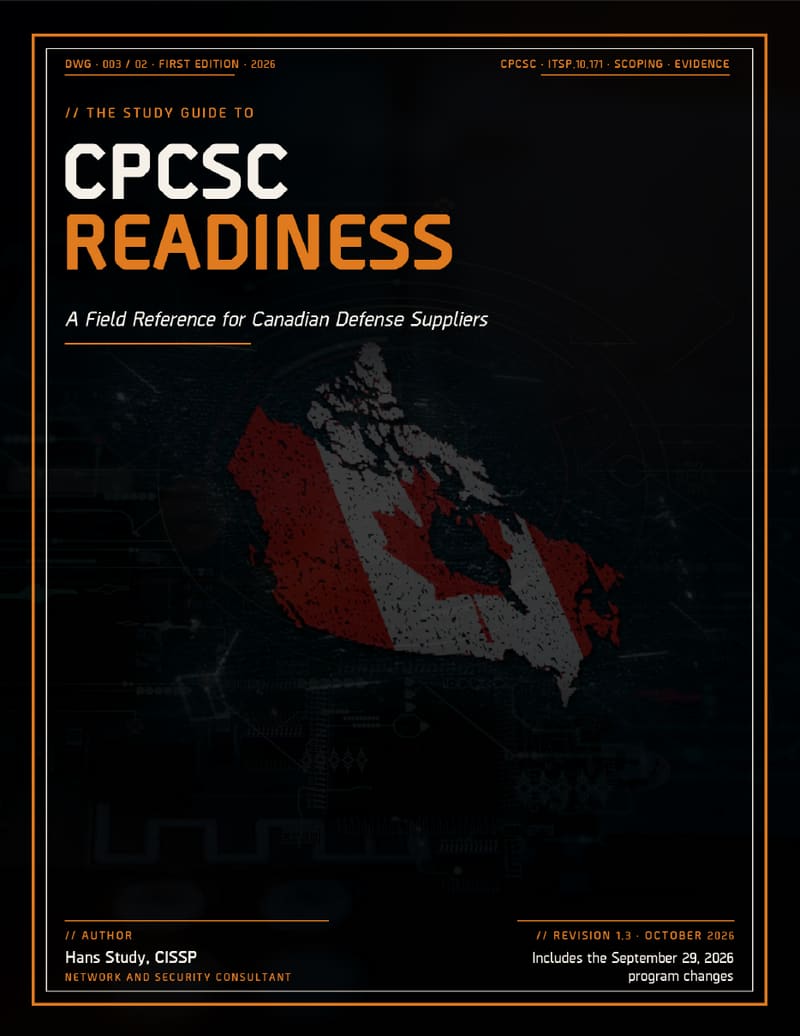
A free field guide and companion resources for Canadian defence suppliers preparing for CPCSC scoping, assessment, attestation, and certification can help you navigate the process. Hans Study offers a structured approach that breaks down the requirements into actionable steps. It is designed for small teams and does not assume you have a dedicated security department. Using it alongside your internal work can save time and reduce the risk of missing something important.
One common mistake is trying to do everything at once. Pace yourself. The certification process is not a sprint. Allow time for policies to be adopted and for staff to become comfortable with new procedures. If you hit a roadblock, revisit the responsibility matrix and see if the task can be reassigned or if it truly requires outside help. A good rule of thumb is that if you can describe the control in plain language and identify the evidence needed, you can probably implement it internally.
What this means for your business
For a small defence supplier, the ability to handle CPCSC implementation internally is not just about saving money. It builds competence and ownership within your team. When your staff understand why a control exists and how it works, they are more likely to maintain it. This reduces the long-term cost of compliance. It also makes your business more resilient. A supplier that has internalized its security practices is better prepared for audits, customer questions, and real incidents.
You do not need to become a security expert overnight. But by taking the time to learn the standard, assess your own environment, and implement controls step by step, you position your company as a reliable partner. The certification itself is a credential that opens doors to larger contracts and primes you for future business. With a systematic approach and the support of a resource like Hans Study, the path becomes clearer and the workload manageable. Every small step you take internally is an investment in your company's future.
❧